
Introduction
- North Tyneside has a transport strategy. Its vision is:
“Moving to a green, healthy, dynamic and thriving North Tyneside”
One of the key principles underpinning the strategy is to reduce carbon emissions from transport.
- This supports the ambition of the Our North Tyneside Plan 2021 to 2025, which commits to publishing an action plan of the steps we will take and the national investment we will seek to make North Tyneside carbon net-zero by 2030, and reflects the Authority’s declaration of a climate emergency, made in July 2019.
- This strategy aims to support the take-up of zero emission vehicles (ZEVs, which includes both pure electric vehicles and hydrogen fuel cell vehicles) in preference to petrol or diesel vehicles in the borough. It is important to recognise that it is not the intention to increase the number of vehicles on our roads, but to ensure that a far higher proportion of vehicles on our highway network are zero emission. Together with improvements to cycling, walking and public transport this will help to realise our Climate Emergency aims.
- In 2018 Government published ‘The Road to Zero’, which seeks to put the UK at the forefront of the design and manufacturing of ZEVs. The Government has since confirmed that it will end the sale of new petrol and diesel cars and vans by 2035, and has introduced a ZEV mandate which specifies that by 2030, 80% of new cars and 70% of new vans should be ZEVs.
- As a result, we know that the prevalence of ZEVs is set to continue to rise and that ZEVs will ultimately replace petrol and diesel vehicles.
- The Authority has a leadership role to play and has already taken a number of steps such as introducing electric vehicles into its own fleet and working with partners to install modern Rapid chargepoints, which can charge an EV to 80% in around 40 minutes, at several of the Authority’s public car parks.
- Nevertheless, the Authority is not a mainstream fuel provider to the public or businesses. We therefore would not anticipate becoming the long-term default provider for EV chargepoints.
- ZEVs and the charging infrastructure they require are relatively new and developing technologies. Whilst much of the focus is currently on electric vehicles, innovation and development is happening all the time across a range of alternative fuel sources. It will be important to be ready to quickly respond to future changes and hence this strategy and action plan is suitably flexible and responsive.
- This strategy sets out the objectives and actions which we will implement to support and facilitate an inclusive move to ZEVs in preference to petrol or diesel, and help to deliver our challenging carbon net-zero commitments. The strategy will support the realisation of the aims in the North Tyneside Transport Strategy and the Our North Tyneside Plan.
Background information
- The majority of vehicles in the borough run on either petrol or diesel, causing air pollution which can be harmful to health. ZEVs are more sustainable than petrol or diesel vehicles for many reasons:
- ZEVs release zero tailpipe emissions at street level, improving air quality in urban areas
- Emissions from electricity generation or hydrogen production usually take place away from street level where they have highest human health impacts
- Electric vehicles can be powered by electricity produced from sustainable energy sources. There is scope for the UK’s electricity supply to decarbonise further, if gas-fired power generation is replaced by increased use of renewable energy and other low-carbon energy sources
- This means that, although battery production has some environmental implications, the lifetime carbon footprint of manufacturing, running and disposing of an electric vehicle or hydrogen fuel cell vehicle is lower than for a conventional fossil fuel vehicle
- ZEVs (or hybrid vehicles running in electric mode) are very quiet compared with petrol and diesel vehicles. This has benefits for residents living alongside busy roads, and has benefits for the natural environment from reduced vehicle-borne noise pollution.
- All motor vehicles produce some emissions of local air pollutants, e.g. fine particulates from brake and tyre wear. As such, while ZEVs generate considerably less local air pollution than other vehicles, cycling, walking and wheeling remain the cleanest ways to travel.
- ZEVs can also be more affordable for residents and businesses as they generally have lower running costs for servicing and maintenance than petrol or diesel vehicles, although the vehicles themselves are still relatively expensive to acquire. However, the price of EV batteries is likely to continue its broadly decreasing trend as manufacturing techniques improve and, as one of the main costs at present for ZEVs is in the batteries, this will in time contribute to greater affordability and mass market appeal.
- Charging a vehicle at home and overnight is convenient, often more affordable, and is likely to have a lower carbon footprint, as it uses electricity at an off-peak time when reduced demand on the grid allows greater use of lower-carbon electricity generation. Government grants are available for both householders and businesses to install EV chargepoints.
- Advances in EV chargepoint design, which allow the possibility of ‘off-grid’ chargepoints using a solar canopy, also help to make it possible for commercial providers to install chargepoints in a wider range of locations.
- In addition, it should be recognised that e-bikes (pedal-powered, electrically assisted cycles) and e-cargobikes (incorporating a trailer for carrying goods) are increasingly viable alternatives to car or van use for a range of journeys, particularly at local level.
Challenges
- The development of new ZEV infrastructure is largely dependent on actions taken by the commercial sector, e.g. the motor industry and retailers, and by individual businesses and residents. This strategy therefore sets out the objectives and actions to enable the Authority to take a leadership role. The Authority will implement measures, with a focus on assisting and facilitating an inclusive move to ZEVs in preference to petrol or diesel. Together with wider actions taken by the commercial sector and individuals, this will help to deliver our challenging carbon reduction commitments for the borough.
- Many car users cover limited mileage during the week, and battery and motor technology is improving, resulting in EVs being available which can cover a greater range than was previously the case. As such, EV users who do not have a drive or other private off‑street parking and who cover an average commuting distance will often only need to charge their EV relatively infrequently, e.g. twice in a week.
- Publicly accessible electric vehicle chargepoints are available at a wide and growing range of destinations throughout the borough such as shopping centres, business parks and Metro stations, and are set to become rapidly more widespread as the commercial provision of chargepoints increases to reflect growing demand.
- Nonetheless, EV users report a desire for more extensive publicly available charging, including faster options such as Rapid chargepoints, to overcome ‘range anxiety’ (lack of confidence that an EV can cover a certain length of journey) and ensure people are confident they can also use EVs for longer journeys: this is particularly important for the visitor economy.
- In addition, there is demand for on-street charging for people who do not have a driveway or private off-street parking, e.g. at terraced properties.
- There are also opportunities to introduce further EV chargepoint provision on sites within the Authority’s control, such as our public car parks.
-
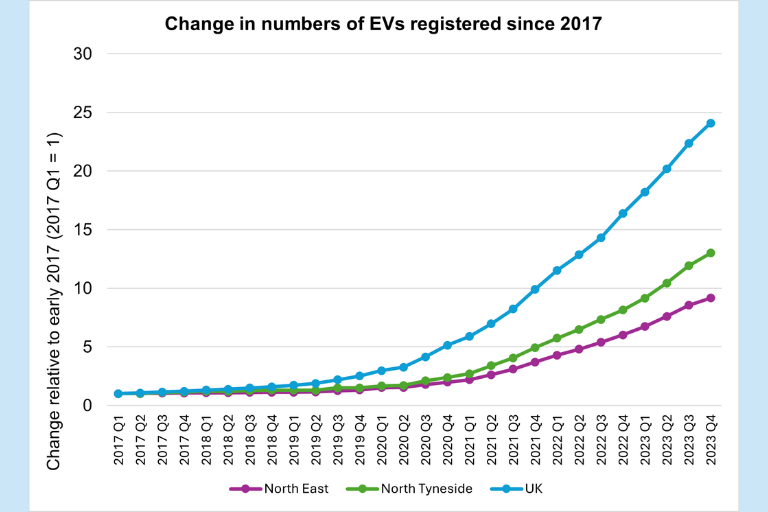
More broadly, new registrations of ZEVs are rapidly rising (see graph below). The North East ZEV Strategy notes that as at Spring 2023, 1.06% of vehicles licensed in the North East were EVs (not including hybrid vehicles), a figure which is set to increase as take-up of ZEVs grows. If rising demand is not matched by suitably convenient supply, this could discourage some users or businesses from adopting ZEV technology.
Image
- To be convenient and minimise range anxiety, it is important for the network of publicly available charging infrastructure to be not only reasonably widespread but also reliable and well maintained, so that users are confident that a chargepoint will function when they need it. It is also an advantage for users if chargepoints accept card payments or use a standard smartphone app for payment, thereby avoiding the need to download numerous apps from different chargepoint operators.
- There are distinct challenges for taxi, bus and freight operators in adopting ZEV technologies. The Authority has amended its Taxi and Private Hire Licensing Policy to include a vehicle emissions criterion which, in stages, will ensure that remaining petrol and diesel vehicles meet modern emissions standards and will also assist in encouraging the take-up of ZEVs in preference to petrol and diesel.
- Some fully electric buses are already operating in Tyne and Wear and the Authority, with partners, has been involved in bidding for funding for additional electric buses.
- The Government has consulted on plans to set a date to end the sale of new non zero-emission heavy goods vehicles (HGVs).

What we will do
- We will continue to introduce more ZEVs into our own fleet where appropriate, taking into consideration external advice such as the independent review previously undertaken by the Energy Saving Trust, and, as the technology develops and appropriate models become available, we will introduce ZEVs for specific activities such as refuse collection vehicles.
- We will encourage people to install EV chargepoints at home, and businesses to install chargepoints at their premises, whenever possible. Government grants are available, subject to grant conditions, for residents and businesses who have private off-street parking to install EV chargepoints.
- We will continue to ensure that EV charging provision is included as part of new developments, whenever appropriate, so that ZEV use can be a convenient option for residents or businesses from the moment they move in.
- We will install more EV chargepoints at our public car parks and leisure centre car parks across the borough, to increase the opportunities for residents, visitors and business users to charge their vehicles when out and about in North Tyneside. In addition, making provision for disabled access at chargepoints will be a design consideration when these are installed or renewed.
- We will seek opportunities to install EV charging provision at our offices, providing charging facilities for staff use and our fleet vehicles.
- In the context of overall provision in the borough, where there are areas of terraced streets where houses do not have private off-street parking, the Authority will work with commercial operators and funding providers on the potential to seek funding for charging provision at local level. For example, the Authority has worked with the North East Combined Authority and other authorities in the region on potential funding from the Government’s Local Electric Vehicle Infrastructure (LEVI) fund. Provision in such areas could involve either a form of on‑street charging infrastructure, subject to funding being available, or off-street provision such as charging ‘hubs’, e.g. at car parks or public buildings in the area, depending on local circumstances. Wherever possible we will seek to ensure that such solutions do not generate additional street clutter or maintenance and management challenges.
- We will work with third party providers as appropriate to maximise the number of locations available for EV charging, alongside any potential opportunities to offer refuelling facilities for hydrogen vehicles.
- We will support the transition of public transport and commercial vehicles to ZEVs. This will include engaging with the region’s bus operators in the context of the North East Bus Service Improvement Plan; with the taxi trade through established forums; and with freight operators through forums such as the North East Freight Partnership.
Our action plan
This section expands on the points above to set out a number of specific actions which we will undertake to deliver the aims of the strategy.
| Leadership | Action 1: |
Continue to implement a phased implementation and replacement programme for our fleet vehicles, where technically practicable, and supporting infrastructure, leading up to the target year of 2030 and linked to the Authority’s investment plan
|
| Action 2: |
Require developers to provide EV charging, and associated measures such as ZEV car club provision as appropriate, as part of new developments
|
|
| Action 3: |
Upgrade and expand the existing network of EV chargepoints in the Authority’s car parks and premises. Where a suitable electricity grid connection can be obtained, we will:
|
|
| Action 4: |
In areas of terraced streets where a substantial number of houses do not have private off-street parking, we will review opportunities to seek external funding and work with commercial operators on potential provision. This is likely to involve various types of EV charging technologies and to involve utilising both off‑street and on-street provision to reflect local circumstances, while seeking to avoid generating additional street clutter or maintenance and management challenges.
|
|
| Action 5: |
Incorporate the aims of this strategy into other local policies and strategies
|
|
|
Influencing
|
Action 6: |
Promote and encourage the uptake of EV chargepoints by householders and businesses
|
| Action 7: |
Working with partner organisations – such as the North East Combined Authority and Nexus, large employers and destinations such as retail sites, e.g. through the Go Smarter in North Tyneside programme – we will advocate the uptake of opportunities to provide additional EV chargepoints for use of staff and the public, and associated measures such as ZEV car club provision.
|
|
| Action 8: |
Encourage an increase in the uptake of zero emission buses and taxis (hackney carriages and private hire vehicles)[1], working with regional partners, including exploring any opportunities to provide hydrogen refuelling facilities
|
Progress against the targets above will be summarised in the report to Cabinet as part of the North Tyneside Transport Strategy Annual Report.
Annex 1 – Policy Background
The North Tyneside Transport Strategy provides the overall strategic context for transport in the borough, as described in section 1 of the main report.
This is supplemented by the following policies and strategies related to transport:
North Tyneside Transport and Highways Supplementary Planning Document (SPD) – refreshed October 2022
This document sets out in detail the policies and procedures adopted by the Authority with regards to the traffic and transport impacts of new development. It focuses on the need to ensure sustainability in all new development and improved connectivity to local centres, schools and employment sites through new and enhanced infrastructure.
The document specifies that the provision of EV charging points as part of new developments should, as a minimum, meet the standard set out in Building Regulations. It also notes that, as part of a Travel Plan and alongside other incentives, it may be appropriate for developers to propose the provision of a ZEV ‘car club’.
North Tyneside Parking Strategy – refreshed August 2022
The North Tyneside Parking Strategy sets out the Authority’s approach to managing parking both in its own car parks and on the highway network.
It includes objectives to provide chargepoints for electric vehicles in the Authority’s car parks, and more broadly to facilitate dedicated provision for electric vehicles and ‘car clubs’ (locally-based car hire which can provide an alternative to car ownership).
Highway Asset Management Plan (HAMP) – adopted September 2017
The HAMP sets out the Authority’s strategic approach to highway and infrastructure maintenance.
When designing new infrastructure for zero emission vehicles (ZEVs), future maintenance liability is one of the relevant considerations.
North Tyneside Cycling Strategy – refreshed June 2023
The Cycling Strategy supports and encourages the growth of everyday cycling in the borough: this includes partnership working on projects which get more people cycling, and improving cycling infrastructure and information. It includes as an appendix the Authority’s Local Cycling and Walking Infrastructure Plan (LCWIP), which provides a detailed review and assessment of strategic cycling routes across the borough and links for walking and wheeling in town centres.
The strategy is supported by the North Tyneside Cycling Design Guide which provides design guidance to make sure that cycling is considered as part of all highway and regeneration projects and any new infrastructure is in line with best and emerging good practice.
The strategy states that designs will take account of the many variations to a standard two-wheeled bike, such as ‘cargo bikes’ which carry light goods. It also notes that any type of cycle may be an e-bike, where the rider operates the pedals as normal and an electric motor provides additional power. E-bikes and cargo bikes can offer a viable alternative to a motor vehicle for numerous journeys and can offer further reductions in pollution compared with ZEVs, as they require less energy to manufacture and can generate fewer particulates from brake and tyre wear.
North Tyneside Travel Safety Strategy – adopted March 2018
The Strategy sets out how the Authority intends to further improve road safety by reviewing and improving infrastructure, increasing awareness and education of road safety matters and working in partnership to address travel safety concerns on the Authority’s transport network.
One of the actions in the strategy states that we will work with partners to promote safe travel more widely in the community, including raising awareness of relevant activities and events. Such activities and events could also involve encouraging the take-up of ZEVs in preference to petrol or diesel vehicles.
North Tyneside Network Management Plan – adopted October 2018
The Network Management Plan sets out how the Authority intends to “manage the peaks” in highway operations using a corridor-based approach to manage demand on the network through better use of technology, promoting behavioural change and investing in infrastructure improvements when it is appropriate to do so.
The document notes that the challenge of the Network Management Plan is to balance competing road user demands whilst also improving air quality and reducing carbon emissions. It also seeks to enable and encourage informed choice and the wider use of active and sustainable ways to travel.
North Tyneside Home to School/College Transport Policy – reviewed May 2021
Home to school/college transport involves partnership working between the Authority, transport and education providers and parents and carers. The Authority also has a duty to ensure, in certain cases, that suitable travel arrangements are made to facilitate children’s attendance at relevant educational establishments.
The policy sets out how the Authority will implement an approach to reflect these considerations and provides guidelines in a clear and comprehensive manner on the procedures which are followed.
North Tyneside Hackney Carriage and Private Hire Licensing Policy – adopted September 2023
The policy sets out how the Authority will discharge its responsibility for the licensing of hackney carriage and private hire vehicles, their drivers, and in the case of private hire vehicles their operators, within the borough.
Among its objectives are to ensure that vehicles are safe, clean, reliable and accessible to meet the varying needs of the public; to provide confidence in the system for assessing whether a person is ‘fit and proper’ to drive a hackney carriage or private hire vehicle; and to encourage the uptake of zero and ultra-low emission vehicles.
Annex 2 - Cable matting and the public highway
Following a number of requests as to the Authority’s position with regard to the use of cable matting (cable protectors) crossing the public highway (including footways), a review of the subject has been undertaken.
This review has taken into account examples of the approach taken by other local authorities, and has considered the Highways Act 1980 and associated highway legislation.
In relation to cable matting, consideration has been given to the position taken by other local authorities in the North East and examples from local authorities across England. It appears that in a substantial majority of areas, local authorities are not authorising cable matting as a solution to cater for EV charging cables from domestic properties. The rationale for this is predominately around risk factors and implications for footway users.
The potential impact on other highway and footway users is a significant consideration. These may cause inconvenience for visually impaired people or for wheelchair users or people pushing prams or pushchairs, for example, particularly if several cable protectors are installed in the same street.
When used for charging an EV, cable matting is often left in place for a number of hours, with potential to cause difficulty for substantial numbers of highway users. This can also pose issues for access to the highway by road sweepers, or potentially for utility companies or their contractors.
There could also be adverse implications for safety, for example if a cable protector is dislodged by rainwater or obscured by snow or leaf fall, or more generally damaged through wear and tear. As users may not be able to park directly outside their properties, there is a further safety risk of sections of cable being left trailing across the highway between the cable protector and the vehicle.
The Authority does not authorise or advocate the use of cable matting crossing the highway for EV charging.