Future Climate Scenarios
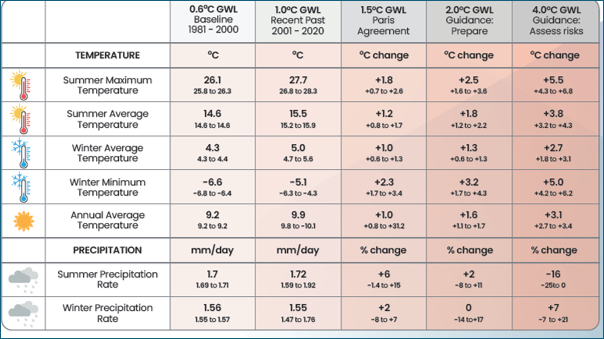
The UK Met Office has produced climate scenario Local Authority Climate Reports for all council areas. These provide future projections for climate change impacts, such as temperature, rainfall, and sea level rise. The illustration below shows projections for North Tyneside in which all modelled scenarios point to hotter, drier summers and warmer, wetter winters. A rise in sea levels can also be expected.
This highlights the need to prepare for future changing climates, today. If local, national, and global mitigation measures are effective, a medium emissions scenario of 2oC global warming level could be achieved, meaning the risk of climate change impacts is reduced. However, if action is not taken to reduce carbon emissions, we could expect a high emissions scenario of 4oC which could result in more intense weather events.